


Decoding Your Air Handler Control Board: What It Is and Where It Hides
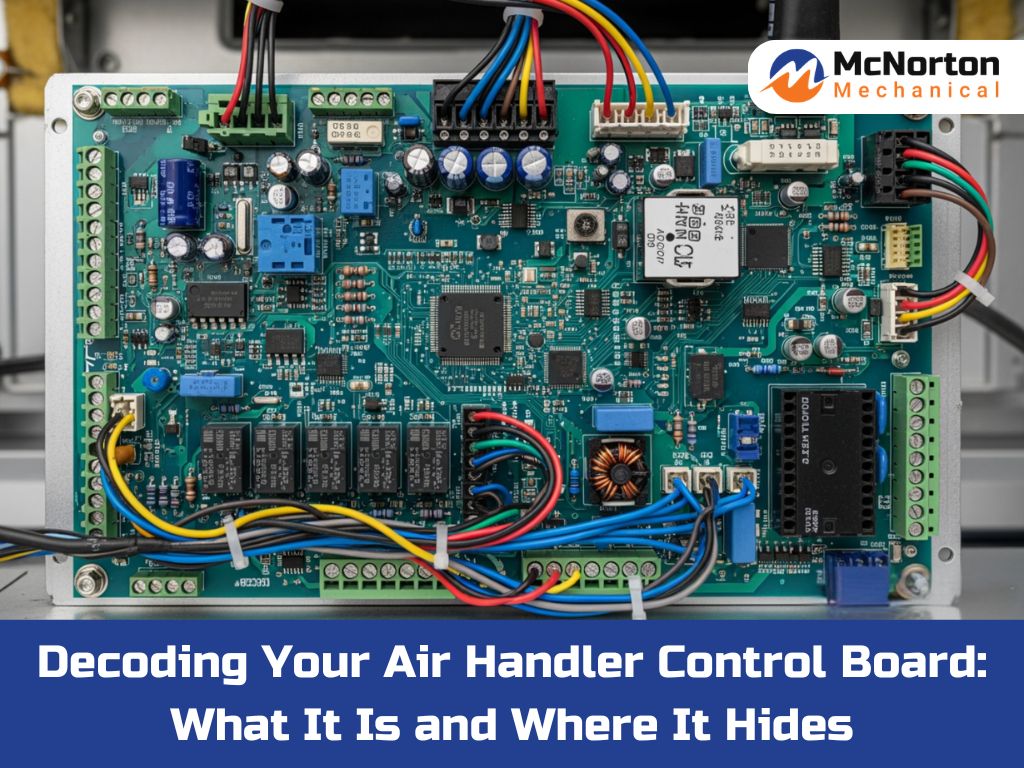
The Brain of Your HVAC: What an Air Handler Control Board Does
Air handler control boards are the command centers of your HVAC system—small circuit boards that manage everything from your blower fan to communication with your outdoor compressor. Here’s what you need to know:
- What it is: A circuit board that acts as the “brain” of your air handler, coordinating all system operations
- What it does: Sends voltage to components, monitors safety switches, and executes commands from your thermostat
- Where it’s located: Inside your air handler unit, typically behind an access panel
- Common issues: System won’t start, fan runs constantly, intermittent operation, or burnt smell
- Replacement cost: Parts typically range from $25-$300, plus labor if professionally installed
If your air handler suddenly stops responding to your thermostat, or your blower motor refuses to turn off, the control board is often the culprit. This small but critical component coordinates and executes the operation of various components by sending voltage when and where needed, while constantly monitoring sensors and safety switches throughout your system.
Think of it this way: your thermostat tells the system what to do, but the control board figures out how to do it. It decides when to fire up the blower, when to signal the compressor, and when to shut everything down if a safety issue arises.
The challenge for many Pensacola homeowners is that when this component fails, the entire system can stop working—often at the worst possible time during our sweltering summers or unexpectedly cold winter nights. And because control boards are electronic components, they’re vulnerable to power surges, moisture, and the simple wear that comes with Florida’s demanding climate.
I’m Derrick Rushnell, and in my years with McNorton Mechanical, I’ve diagnosed countless air handler control board failures and helped homeowners understand when repair makes sense versus when replacement is the smarter choice. Let me walk you through everything you need to know about this essential component.
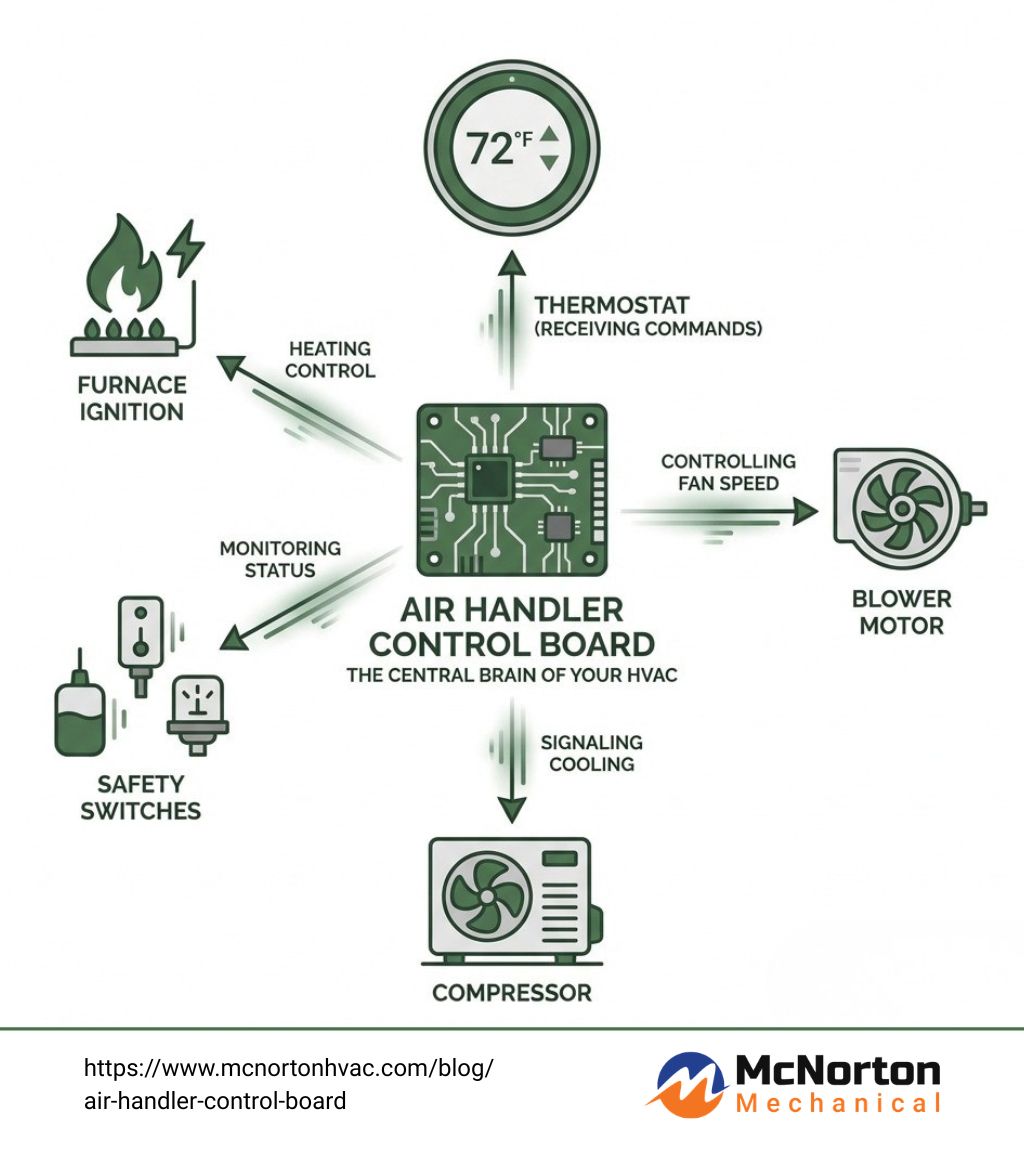
An air handler control board is essentially the central nervous system of your indoor HVAC unit. It’s an integrated circuit board designed to manage the precise operation of your air handler, ensuring your home stays comfortable. Without it, your air handler would be just a collection of parts, unable to communicate or function together. It’s the “brain” that brings the whole system to life, coordinating essential tasks and reacting to various inputs to deliver conditioned air efficiently and safely. For instance, the Rheem-Ruud 47-102606-85 Control Board is highlighted as an essential component for efficient and reliable operation.
How the Control Board Interacts with Your System
The air handler control board doesn’t work in isolation; it’s constantly communicating with other parts of your HVAC system. Its primary role is to interpret signals from your thermostat and translate them into actions for the various components of the air handler and even the outdoor unit.
Here’s a closer look at these vital interactions:
- Thermostat Signals: When you adjust your thermostat to cool or heat your home, it sends low-voltage signals (typically 24V) to the control board. For example, the
Ywire signals a call for cooling,Gfor the fan, andWfor heating. The control board receives these signals and initiates the appropriate sequence of operations. - Blower Motor Control: One of the control board’s main responsibilities is managing the air handler’s blower motor. It determines when the fan should turn on, how fast it should run (especially in multi-speed or variable-speed systems), and when it should turn off. This ensures proper airflow through your ductwork, distributing conditioned air throughout your Pensacola home.
- Compressor Communication: For cooling, the control board sends a signal to the outdoor condensing unit, telling the compressor to turn on. This coordinated effort ensures that the refrigerant cycle begins, allowing your indoor coil to cool the air effectively. Some air handler units are even designed to signal the fan and compressor simultaneously, streamlining the cooling process.
- Furnace Ignition (if applicable): In systems that combine an air handler with a furnace, the control board also manages the heating sequence. It ensures the igniter fires, the gas valve opens, and the furnace burners light up, all while monitoring safety parameters. If you’re experiencing issues with your heating system, it could be related to the control board’s interaction with the furnace. For more insights into these issues, you can find more info about heating system failures.
- Safety Switches and Limit Switch Monitoring: The control board is a vigilant guardian. It constantly monitors various sensors and safety switches within the unit, such as limit switches, pressure switches, and flame sensors. If any of these detect an unsafe condition (like an overheated furnace or a blocked flue), the control board will shut down the system to prevent damage or hazards. This protective function is crucial for the safe operation of your HVAC system.
The air handler control board orchestrates a symphony of components, ensuring that your HVAC system responds accurately and safely to your comfort demands.
Telltale Signs of a Failing Control Board
When the “brain” of your air handler starts to falter, your entire HVAC system can get confused. Recognizing the common symptoms of a failing air handler control board can help you diagnose the problem early and prevent further issues. Here in Florida, a malfunctioning HVAC system can quickly turn a comfortable home into an unbearable one, so knowing these signs is crucial.
Here are the most common indicators that your control board might be on the fritz:
- System Won’t Turn On: This is perhaps the most frustrating symptom. You set your thermostat, but nothing happens. No fan, no cooling, no heating. The control board might not be receiving or processing the thermostat’s signals, or it could be failing to send power to the necessary components.
- Blower Fan Runs Constantly: Conversely, if your blower fan never seems to turn off, even when the thermostat is set to “off” or the desired temperature has been reached, the control board might be stuck in an “on” command for the fan. This wastes energy and can wear out your fan motor prematurely.
- Intermittent Operation: Does your system turn on and off unpredictably? Does it work for a while, then stop, only to restart later? This erratic behavior can be a sign of a failing control board struggling to maintain consistent operation or losing power intermittently.
- Burnt Smell: A distinct burnt or acrid smell coming from your air handler is a serious warning sign. This could indicate an electrical component on the control board (or elsewhere) is overheating or short-circuiting. If you notice this, turn off your system immediately at the breaker.
- Visible Scorch Marks: If you’re comfortable opening the air handler’s access panel (after ensuring the power is off!), you might see visible scorch marks, discoloration, or even melted components on the control board itself. These are clear signs of electrical damage.
- Clicking Noises: While some clicking noises are normal during HVAC operation (e.g., relays engaging), excessive or unusual clicking, especially without the system turning on, could indicate a faulty relay on the control board constantly attempting to engage a component without success.
- No Response from Thermostat: You change settings on your thermostat, but your air handler acts like it didn’t get the message. This communication breakdown points directly to the control board’s inability to interpret or act on the thermostat’s commands.
If you notice any of these symptoms, especially during our hot Pensacola summers, it’s time to investigate. Ignoring these signs can lead to more extensive and costly repairs down the line. If you’re dealing with AC issues, don’t hesitate to find help with your find.
How to Diagnose a Faulty Air Handler Control Board
Diagnosing a faulty air handler control board requires a systematic approach and, most importantly, strict adherence to safety protocols. While some checks can be performed by a diligent homeowner, anything involving electrical components carries inherent risks.

Here’s how we approach diagnosing a control board issue:
- Safety Precautions First: Before you even think about opening your air handler, always turn off the power to the unit at your home’s main electrical panel or breaker box. This is non-negotiable. Verify the power is off using a non-contact voltage tester. We deal with 24V (low voltage) and 120/240V (high voltage) components, and an accidental shock is no joke.
- Visual Inspection: Once the power is safely off, open the air handler’s access panel where the control board is located. Look for any obvious signs of damage:
- Scorch marks or burn damage: As mentioned earlier, dark spots or melted plastic on the board or surrounding wires are clear indicators of a problem.
- Swollen or leaking capacitors: These small cylindrical components should be flat on top. If they’re bulging or have residue, they’ve likely failed.
- Loose or corroded wires: Ensure all wire connections are secure and free of rust or corrosion.
- Blown fuses: Many control boards have a small automotive-style fuse (often 3A or 5A, typically purple or tan) that protects the low-voltage circuit. If it’s blown, it will appear broken or discolored.
- Multimeter Testing (for the electrically savvy): For those with electrical knowledge and a multimeter, you can perform voltage checks.
- 24V Power Check: With the power restored (and extreme caution), check for 24V AC at the low-voltage terminals where the thermostat wires connect (typically
RandC). If there’s no 24V, the issue might be upstream (e.g., a faulty transformer). - Output Voltage Checks: You can also test for 24V AC outputs to components like the fan relay (
G) or compressor contactor (Y) when the thermostat calls for them. If the control board receives the input but doesn’t send the correct output, it’s a strong sign of failure.
- 24V Power Check: With the power restored (and extreme caution), check for 24V AC at the low-voltage terminals where the thermostat wires connect (typically
- Diagnostic LED Lights: Many modern control boards are equipped with diagnostic LED lights. These are invaluable for troubleshooting, as they can indicate specific error codes.
- Onboard Fuse Check: As part of your visual inspection, physically remove and inspect any fuses on the control board. If a fuse is blown, it’s often a symptom of an underlying problem, not just the cause. Replacing it might only be a temporary fix if the short circuit that blew it still exists.
Diagnosing a control board can be intricate, and if you’re unsure at any point, it’s always best to call in the professionals. We offer Get help with emergency HVAC repairs for those times when you need expert assistance quickly.
Understanding Diagnostic LED Codes
Modern air handler control boards are designed with built-in intelligence to help technicians (and savvy homeowners) quickly identify problems. Diagnostic LED lights are a prime example of this. These small lights, usually found on the board itself, will blink in specific patterns to communicate error codes or system status.
To properly interpret these codes:
- Locate the Legend: Most air handler service panels, or sometimes the control board itself, will have a sticker or printed legend explaining what different LED blink patterns mean. Keep your eyes peeled for this invaluable guide!
- Manufacturer’s Guide: If there’s no legend, check your air handler’s owner’s manual or look up the specific model number online. Manufacturers provide detailed explanations of their diagnostic codes.
- Common Status Meanings: While codes vary by manufacturer, here are some common LED status meanings you might encounter:
- Solid Light: Often indicates normal operation or standby mode.
- Slow Blinking: Could signify a low-voltage issue, a pressure switch open, or a call for heat/cool.
- Fast Blinking: Might point to a high-voltage problem, a lockout condition (e.g., after multiple failed ignition attempts), or a specific component failure like a limit switch.
- Specific Blink Patterns (e.g., 2 flashes, pause, 2 flashes): These often correspond to very specific faults, such as a “failed ignition,” “pressure switch stuck open,” or “rollout switch tripped.”
Understanding these codes can significantly narrow down the problem, saving diagnostic time and potentially repair costs. However, these codes only point to the symptom, not always the root cause. For example, a “limit switch tripped” code tells you the switch activated, but not why (e.g., dirty filter, blocked return, faulty fan motor).
Replacement Options: Choosing the Right Control Board
When your air handler control board gives up the ghost, you’re faced with the decision of how to replace it. This isn’t always as simple as ordering a new one, especially with older systems common in our Pensacola service areas.
Here are your main options and what to consider:
- OEM Parts (Original Equipment Manufacturer): These are direct replacements made by the original manufacturer of your air handler (e.g., Goodman, Rheem, Carrier). They are designed to fit perfectly and function exactly as the original.
- Pros: Guaranteed compatibility, reliable performance, often comes with a manufacturer’s warranty.
- Cons: Can be more expensive, especially for proprietary boards. May be difficult to find for older or obsolete models. For example, specific Rheem-Ruud boards like the 47-102606-85 are readily available, but others might not be.
- Sourcing Compatible Replacements (Aftermarket/Universal): When an OEM board is obsolete or too expensive, aftermarket or “universal” control boards can be a viable alternative. Brands like ClimaTek offer exact replacements for various part numbers.
- Pros: Often more affordable, wider availability for older units, can sometimes offer improved features.
- Cons: Compatibility needs careful verification, wiring might be different and require adaptation, may not always have the same lifespan as OEM, installation might be more complex.
- Dealing with Obsolete Boards: This is a common challenge for older systems. If the original OEM board is no longer manufactured, you might need to explore universal alternatives. Sometimes, a simpler approach using separate relays and a 24VAC transformer (often called a “fan center”) can be engineered by an experienced technician to replicate the board’s essential functions, particularly for fan control. This can be a cost-effective way to extend the life of a 20-year-old system.
- Importance of Professional Installation: While we encourage homeowners to understand their systems, replacing a control board involves high-voltage wiring, intricate low-voltage connections, and precise component matching. Incorrect installation can lead to system damage, electrical hazards, or inefficient operation. For these reasons, professional installation is almost always recommended.
Here’s a quick comparison of replacement considerations:
| Consideration | OEM Parts | Aftermarket/Universal Parts |
|---|---|---|
| Cost | Higher | Generally lower |
| Compatibility | Guaranteed match | Requires careful cross-referencing and verification |
| Installation | Straightforward “plug-and-play” | May require wiring modifications, more complex |
| Availability | Good for current models; difficult for obsolete | Better for obsolete models; wider range of options |
| Warranty | Manufacturer-backed | Varies by brand; may be shorter or less comprehensive |
Ensuring Compatibility When Replacing Your Air Handler Control Board
Choosing the right replacement board is paramount. An incompatible board, even if it physically fits, can cause severe electrical issues, damage other components, or simply prevent your system from working.
- Part Number Cross-Reference: The most reliable way to ensure compatibility is to match the original part number exactly. Look for the part number printed directly on your existing air handler control board. Websites like North America HVAC often list which OEM part numbers their replacement boards are compatible with, such as Goodman Amana Janitrol B13707-35.
- Wiring Diagrams: If you’re considering a universal board, you’ll need to compare its wiring diagram to your air handler’s schematic. This ensures that all necessary functions (fan, compressor, heating, safety switches) can be properly connected. This is where expertise truly comes into play, as thermostat wiring, for instance, can be complex, especially if you have multiple heating sources or an older system.
- Importance of Professional Consultation: Given the complexity and potential for costly errors, we strongly recommend professional consultation. Our technicians are experts at identifying the correct replacement board, whether it’s an OEM part or a suitable universal alternative, and ensuring it’s installed safely and correctly. Sometimes, integrating an older system with newer components or alternative controls (like using a fan center with a 24VAC supply and a blower relay) requires a deep understanding of HVAC electrical systems. For expert guidance, don’t hesitate to Contact McNorton HVAC for expert guidance.
The Cost of Replacing an Air Handler Control Board
Understanding the cost implications of replacing an air handler control board is crucial for homeowners in Pensacola and the surrounding areas. The decision often boils down to part cost, labor, and the overall age and condition of your HVAC system.
- Part Cost: The cost of the control board itself can vary widely. Simple, older boards might be as low as $25-$75, while advanced, multi-stage, or variable-speed control boards can range from $200 to $600 or more. For example, a Goodman Amana Janitrol board can be found for under $50, while a Rheem-Ruud board might be closer to $180.
- Labor Cost: If you hire a professional (which we highly recommend), labor will be a significant portion of the total cost. Technicians charge for their diagnostic time, expertise, and the time it takes to safely replace and test the new board. Labor costs can vary based on the complexity of the job and your location.
- DIY vs. Professional: While a DIY replacement might save on labor, it comes with significant risks. Incorrect wiring can damage the new board, other HVAC components, or even pose a fire hazard. Given the electrical nature of the repair, the peace of mind and safety provided by a licensed professional often outweigh the perceived savings of a DIY attempt.
- System Age: The age of your entire HVAC system plays a critical role in the repair vs. replace decision. If your air handler is nearing the end of its typical lifespan (15-20 years), investing several hundred dollars in a new control board might not be the most economical choice, especially if other components are also showing signs of wear. Sometimes, replacing an entire system can be more cost-effective in the long run due to improved efficiency and new warranties.
- Repair vs. Replace Decision: This is the big question. If your system is relatively new and well-maintained, a control board replacement is a straightforward repair. However, for older systems with multiple failing components, or if the cost of the board plus labor approaches a significant percentage of a new system, it might be time to consider an upgrade. We often help homeowners weigh these options, considering the remaining lifespan of the unit, energy efficiency gains from new technology, and overall comfort needs.
Delaying necessary HVAC repairs can lead to more severe problems and higher costs down the road. Learn more about Why you shouldn’t delay HVAC system repairs.
The Replacement Process: A Brief Overview
Replacing an air handler control board is a task that demands precision and electrical safety. While we always recommend professional service, understanding the steps involved can help you appreciate the work and ensure you’re making informed decisions.
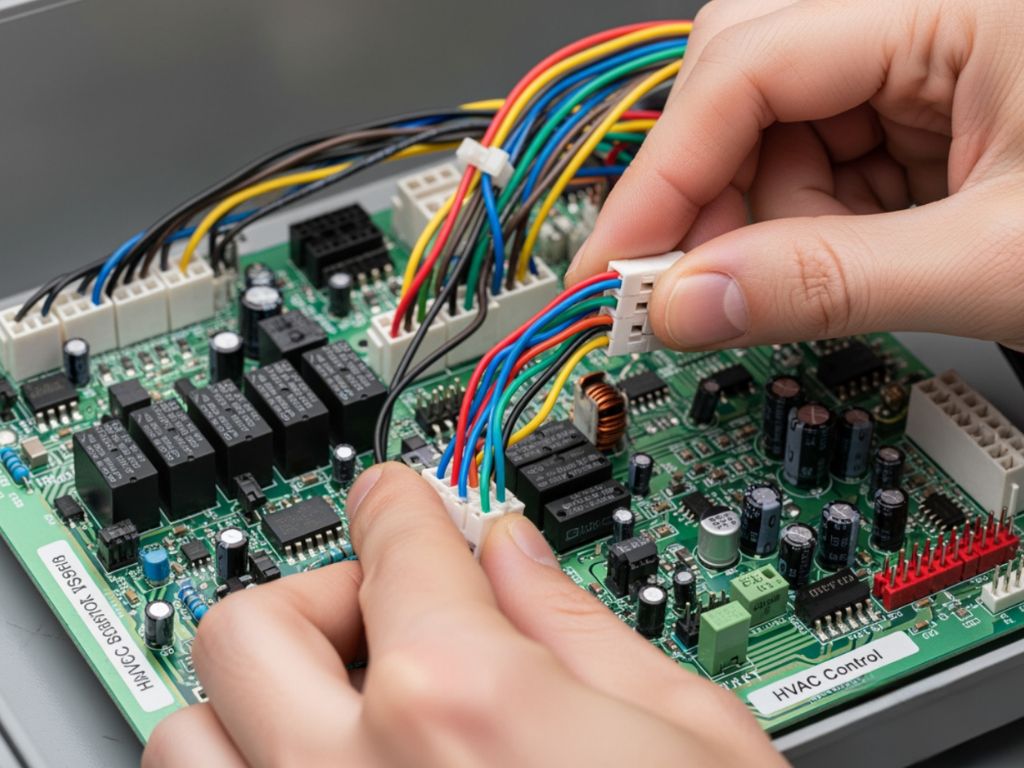
Here’s a general overview of the process:
- Safety Warning & Power Disconnection: As emphasized, this is the absolute first step. Turn off the power to the air handler at the main breaker. Use a voltage tester to confirm that no power is reaching the unit. This step protects you from electrical shock.
- Access the Control Board: Open the air handler’s access panel. The control board is typically mounted inside the blower compartment or in a dedicated electrical compartment.
- Labeling Wires & Taking Photos: Before disconnecting anything, a professional technician will carefully label every wire connected to the old board. They’ll also take multiple photos from different angles. This documentation is critical for ensuring that every wire is reconnected correctly to the new board. There can be dozens of wires, each serving a specific function (thermostat signals, blower motor, safety switches, etc.).
- Removing the Old Board: Once all wires are labeled and disconnected, the old control board can be unmounted. It’s usually held in place by screws, clips, or standoffs.
- Mounting the New Board: The new air handler control board is carefully installed in the same location as the old one, ensuring it’s securely fastened.
- Reconnecting Wires: This is where the labeled wires and photos become invaluable. Each wire is systematically reconnected to its corresponding terminal on the new board. Double-checking each connection is a must to prevent miswiring.
- Testing the System: After all connections are made and the panels are secured, the power can be restored. The technician will then initiate a call for heating and cooling from the thermostat, watching the system’s response. They’ll check fan operation, compressor engagement, and listen for any unusual noises. They’ll also verify diagnostic LED codes (if present) to ensure normal operation.
This meticulous process ensures that your new control board functions flawlessly and that your air handler operates safely and efficiently. For expert guidance and professional service in the Pensacola area, our team is ready to help with Expert air handler repair services.
Conclusion: Keeping Your HVAC System’s Brain in Top Shape
The air handler control board is undeniably the unsung hero of your HVAC system, tirelessly coordinating the complex dance of components that keep your home comfortable in the Florida heat and occasional chill. From interpreting thermostat commands to managing the blower fan, communicating with the compressor, and vigilantly monitoring safety switches, this small circuit board truly is the “brain” of your indoor unit.
We’ve explored how to identify the common symptoms of a failing board, from a completely unresponsive system to a fan that never quits, and even the telltale signs of burnt components. We also walked through the diagnostic process, emphasizing the critical importance of safety and the utility of diagnostic LED codes in pinpointing issues.
When it comes to replacement, understanding your options—whether OEM parts or universal alternatives—and the factors influencing cost can empower you to make the best decision for your home. However, the complexity of modern HVAC electronics means that while a DIY diagnosis is possible, replacement is often best left to a professional. The risk of electrical hazards, system damage, or incorrect wiring far outweighs the benefits of a DIY attempt.
For expert diagnosis and repair of your HVAC system’s electrical components in the Pensacola area, trust the licensed and experienced technicians at McNorton HVAC. With over 65 years of experience, we’re available 24/7 to ensure your comfort and safety. Learn more about our comprehensive electrical panel services.
Latest Articles
Don’t Get Left in the Dark: How to Choose Top-Rated Backup Generator Installers

The Real Cost of Power: What to Expect for Generator Installation