

Shocking Truth: The Real Cost to Replace Your Electrical Panel
What You’ll Pay for an Electrical Panel Replacement
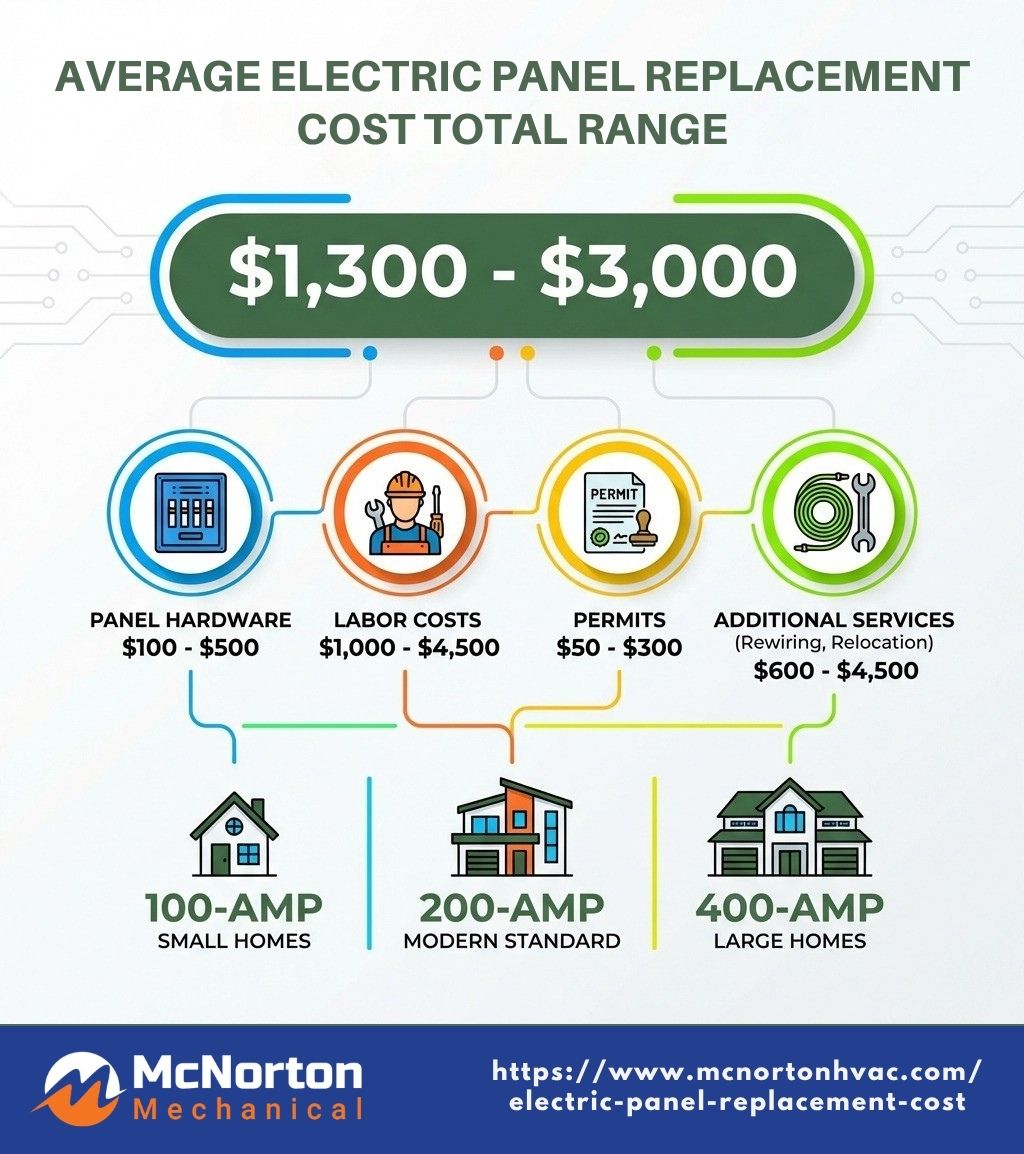
Why can one hidden electrical issue turn a simple upgrade into a major expense? For most homes, electric panel replacement cost runs about $1,300 to $3,000, but complex jobs can climb to $4,500 or more. Do not wait if your panel is outdated or struggling – have McNorton HVAC inspect it before a small problem becomes a costly safety risk.
Quick Cost Breakdown:
- 100-amp panel: $850-$1,150
- 200-amp panel (most common): $1,200-$2,500
- 400-amp panel: $2,000-$4,000
- Labor costs: $1,000-$4,500 (varies by project complexity)
- Permits: $50-$300
- Additional services (rewiring, relocation, drywall repair): $600-$4,500
Your electrical panel is the heart of your home’s power system. It distributes electricity from the utility lines to every outlet, appliance, and light throughout your house. When it’s outdated, overloaded, or failing, you’re not just dealing with flickering lights–you’re facing serious safety risks.
Modern homes demand more power than ever before. We’re running central air conditioning, electric vehicle chargers, smart home systems, and countless devices all at once. If your panel was installed decades ago, it simply wasn’t designed for today’s electrical load. Upgrading isn’t just about convenience–it’s about protecting your home and family from electrical fires, which cause over 51,000 incidents each year according to the Electrical Safety Foundation International.
Professional installation is non-negotiable. Working with high-voltage electricity isn’t a DIY project, no matter how handy you are. Improper installation can lead to electrocution, house fires, code violations, and voided insurance policies. That’s why hiring a licensed electrician isn’t just recommended–it’s essential.
Our team at McNorton Mechanical have spent years guiding Gulf Coast homeowners through electrical upgrades and helping them understand electric panel replacement cost factors. We’ve seen how a properly sized, professionally installed panel can transform both safety and functionality for Florida families.
When to Replace Your Electrical Panel
Just like any other critical system in your home, your electrical panel has a lifespan. Over time, wear and tear, coupled with increasing electrical demands, can render it outdated or even dangerous. Replacing an old or damaged electrical panel is crucial for the safety and efficiency of your home. Each year, electrical issues cause over 51,000 fires, often due to wire housing overheating and melting, leading to power arcing and igniting a fire. We certainly don’t want that happening to your home in Pensacola, Gulf Breeze, or any of our service areas!
Older homes, especially those built before the 1960s, often have electrical panels that are simply not equipped to handle the power needs of today’s appliances and technologies. This could mean a 60-amp or 100-amp box that struggles to keep up. If your home still relies on an outdated fuse box instead of a modern circuit breaker panel, it’s definitely time to consider an upgrade. Fuse boxes, while once standard, are less efficient at preventing overloads and can be a significant fire hazard compared to circuit breakers, which are designed to trip and prevent dangerous situations.
Furthermore, some older panel brands, like Federal Pacific Electric (FPE) and Zinsco, are known for design flaws that pose serious fire risks. If your home has one of these panels, we strongly recommend replacing it as quickly as possible, as they may not trip when overloaded, leading to devastating consequences.
Signs Your Panel Needs an Upgrade
Your home’s electrical system often gives subtle (or not-so-subtle) hints when it’s struggling. Paying attention to these warning signs can help you prevent a small issue from becoming a major problem, or even a hazard. If you notice any of these, it’s time to call in the professionals at McNorton Electrical Heating & Air for an inspection:
- Frequent Breaker Trips: Are your circuit breakers constantly tripping, especially when you use certain appliances? This is a clear indicator that your panel is overloaded and can’t handle the current demand. It’s not just an annoyance; it’s a safety mechanism working overtime, signaling a deeper issue.
- Flickering Lights: Lights that dim or flicker, particularly when a large appliance turns on, suggest your electrical system is struggling to provide consistent power. This can be due to loose connections, an overloaded circuit, or an undersized panel.
- Burning Smell: Any burning odor emanating from your electrical panel or outlets is an immediate red flag. This indicates overheating wires or components and requires urgent attention to prevent a fire.
- Buzzing Sounds: A persistent buzzing or humming sound coming from the electrical panel usually points to loose connections or faulty breakers. These issues can generate heat and are a fire hazard.
- Scorch Marks: Visible scorch marks, discoloration, or melting on the panel itself or around outlets are critical signs of overheating and electrical arcing. This demands immediate professional intervention.
- Rust or Corrosion: Rust or corrosion on the panel, breakers, or wiring can degrade connections, leading to poor conductivity and increased resistance, which generates heat and risks fire. This is especially common in humid environments like Florida.
- Outlets Feel Warm: If outlets or switches feel warm to the touch, it’s a sign of loose wiring creating resistance and heat build-up. This is a fire hazard and needs to be addressed promptly.
- Insufficient Power: If you can’t run multiple appliances simultaneously without issues, or if your home simply doesn’t have enough outlets to meet your needs, your electrical panel might be undersized for your lifestyle.
How Long Does an Electrical Panel Last?
While an electrical panel can last anywhere from 25 to 40 years with proper maintenance, its effective lifespan can be much shorter if it’s constantly overloaded or poorly maintained. Many older panels were only designed for the electrical demands of their time, which were significantly lower than today’s. Even a well-maintained 30-year-old panel might be considered “outdated” simply because it can’t handle modern appliances.
Signs like rust, unusual noises, or frequent breaker trips can indicate that your panel is nearing the end of its functional life, regardless of its age. Additionally, local code compliance changes and evolving insurance requirements might necessitate an upgrade even if your panel seems to be working. For example, if you’re looking to sell your home, an outdated electrical panel can reduce its market value and make it harder to get homeowner’s insurance. We can help you assess the condition of your panel and determine if an upgrade is the right step for your home in Pensacola, Crestview, or any of our service areas.
Understanding the Electric Panel Replacement Cost
The electric panel replacement cost can vary significantly, typically falling between $1,300 and $3,000, but can go higher for more complex projects. This range accounts for various factors including the type of panel, its amperage, labor costs, necessary permits, and even your home’s location. For homeowners in Florida and Alabama, understanding these variables is key to budgeting for this essential upgrade. While we can’t give you an exact figure without an on-site assessment, we can break down what contributes to the overall price. When you’re ready to explore options, comparing quotes from qualified professionals can help you make an informed decision.
Average Costs by Panel Amperage
The amperage (amp) rating of your electrical panel is one of the most significant factors influencing its replacement cost. This rating indicates the maximum amount of electrical current the panel can safely handle. Here’s a general breakdown:
| Panel Amperage | Typical Cost Range (Installed) | Common Use Cases |
|---|---|---|
| 100-amp | $850 – $1,150 | Older, smaller homes with basic electrical needs (minimal large appliances, no central A/C, no EV charging). Often an upgrade from 60-amp. |
| 200-amp | $1,200 – $2,500 | Standard for most modern homes. Handles central A/C, multiple large appliances, hot tubs, and is suitable for most EV chargers. |
| 400-amp | $2,000 – $4,000+ | Very large homes, properties with accessory dwelling units (ADUs), multiple large central A/C units, or extensive workshops/high-demand equipment. |
For most modern homes in our service areas like Foley, Fairhope, or Pensacola, a 200-amp panel is the standard and often the recommended upgrade. It provides ample capacity for today’s electrical demands and future additions like solar panels or more powerful EV chargers. While the parts for a 100-amp panel might be slightly cheaper ($100-$200 for parts) than a 200-amp panel ($250-$350 for parts), the labor costs are often similar. This means upgrading to a 200-amp panel when replacing an older, smaller one is often a more cost-effective choice in the long run, as it future-proofs your home.
Key Factors Influencing Your Electric Panel Replacement Cost
Beyond amperage, several other elements contribute to the final electric panel replacement cost. Understanding these can help you anticipate the total investment:
- Labor Costs: This is often the largest portion of the expense. Electricians typically charge an hourly rate, ranging from $50 to $150 per hour. A standard panel replacement can take 4 to 8 hours, but complex jobs, especially those involving rewiring, can extend to 20 to 30 hours. Our licensed electricians ensure the job is done safely and efficiently, minimizing disruption to your home.
- Project Complexity: Simple panel swaps are less expensive than complete service upgrades. If your existing wiring is outdated or damaged, or if the main service line needs to be upgraded from the utility pole to your home, the complexity (and cost) increases.
- Panel Location: The location of your electrical panel can impact labor costs. An easily accessible indoor panel is generally less expensive to replace than one that requires extensive work to reach, or one that needs to be moved outdoors. Current regulations in some areas even require electrical boxes to be installed outdoors for firefighter safety, which can add to the cost if your current box is inside.
- Accessibility: If your panel is in a cramped space, requires demolition of drywall to access, or involves working in difficult conditions, the labor time and therefore the cost will increase.
- Material Costs: This includes the cost of the new panel itself, individual circuit breakers (standard, GFCI, AFCI), and any necessary wiring. The price of the panel can range from $100 for a basic model to several thousand for a high-end, high-amperage smart panel.
- Permit Fees: An electrical panel replacement always requires a permit from your local municipality. These fees typically range from $50 to $300 and cover the cost of inspection to ensure the work meets local building codes and safety standards. We handle all the necessary paperwork to ensure your project is compliant.
Additional Costs That Affect Your Electric Panel Replacement Cost
Sometimes, a straightforward panel replacement isn’t enough. Other necessary upgrades or repairs can add to your overall electric panel replacement cost:
- Panel Relocation: If your current panel is in a hazardous or inaccessible location, or if local codes require it to be moved (e.g., from indoor to outdoor), this can add $800 to $4,000 to the project. This includes running new wiring and potentially repairing the old location.
- Subpanel Installation: If you’re adding a new area to your home, like a finished basement, garage, or workshop, or if your main panel is full, a subpanel can provide additional circuits. Installing a subpanel typically costs between $400 and $2,000, depending on its size and complexity.
- Wiring and Rewiring: If your home’s existing wiring is old, damaged, or cannot support the new panel’s capacity, extensive rewiring might be necessary. This can add $600 to $4,500, or even more for a full house rewire ($6 to $10 per square foot, or $12,000 to $20,000 for an entire home).
- Drywall Repair: If the old panel location needs patching or if new wiring runs require opening walls, you’ll incur costs for drywall repair, typically $1.50 to $3 per square foot.
- Trenching for Underground Service: For homes with underground electrical service, an upgrade might require trenching to access and replace the service lines, costing between $600 and $2,100.
- GFCI/AFCI Breaker Upgrades: While standard breakers are inexpensive, many modern codes require Ground Fault Circuit Interrupter (GFCI) and Arc Fault Circuit Interrupter (AFCI) breakers for improved safety. These specialized breakers cost $30 to $100 per unit, significantly more than standard ones, but they offer superior protection against electric shock and electrical fires.
The Upgrade Process and Its Benefits
Upgrading your electrical panel is a significant home improvement project that ensures your home’s electrical system is safe, efficient, and capable of meeting your current and future power needs. Our team at McNorton HVAC takes pride in making this process as smooth as possible for our customers across Pensacola, Cantonment, and other Florida and Alabama locations.

The project timeline for a standard panel replacement typically ranges from 4 to 8 hours. However, if the job involves extensive rewiring or other complex additions, it can extend to 20 to 30 hours. During this process, we’ll need to coordinate with your utility company to temporarily shut off power to your home, ensuring the safety of our technicians and your property. Once the installation is complete, a final inspection by the local authorities will verify that all work meets the latest electrical codes and safety standards.
DIY vs. Hiring a Professional Electrician
We can’t stress this enough: replacing an electrical panel is not a DIY task. While we appreciate a homeowner’s can-do spirit, working with high-voltage electricity is incredibly dangerous and can have severe consequences.
- Dangers of DIY: The risks include electrocution, serious burns, and even death. Improper wiring can lead to electrical fires, which can devastate your home and put lives at risk.
- Code Violations: Electrical work is subject to strict local building codes. Without proper knowledge and licensure, you’re almost guaranteed to violate these codes, leading to fines, rework, and potential issues when selling your home.
- Insurance Issues: Homeowner’s insurance policies typically do not cover damages or injuries resulting from unpermitted or improperly installed electrical work. A DIY panel replacement could void your coverage, leaving you financially vulnerable.
Hiring a licensed and insured electrician, like those at McNorton HVAC, is essential. Our professionals have the training, experience, and specialized tools to perform the job safely and correctly, ensuring compliance with all local codes in your area, whether it’s Molino, McDavid, or Foley. You’ll gain peace of mind knowing the job is done right, backed by our expertise and guarantees. When seeking professional help, it’s wise to connect with local experts to ensure they understand regional regulations and can provide reliable service.
Benefits of a Modern Electrical Panel
Investing in a modern electrical panel offers a wealth of advantages that extend far beyond just keeping the lights on.
- Improved Safety: This is paramount. Newer panels and circuit breakers are designed with advanced safety features to prevent overloads, short circuits, and arc faults, significantly reducing the risk of electrical fires and shocks. Upgrading from an old fuse box to a circuit breaker panel dramatically improves your home’s safety.
- Increased Capacity: A modern panel provides the necessary amperage to power all your current appliances and devices without strain. This means no more flickering lights or constantly tripping breakers when you use the microwave and the hair dryer at the same time.
- Support for Modern Appliances: Today’s homes are filled with power-hungry devices, from high-efficiency HVAC systems to smart home technology. An upgraded panel ensures your home can comfortably support these amenities.
- Backup Power Solutions: If you’re considering a whole-home generator for hurricane season in Florida, a robust electrical panel is a prerequisite. It ensures seamless integration and efficient power distribution during outages. McNorton HVAC specializes in generator services, and we can ensure your panel is ready.
- EV Chargers: Electric vehicles are becoming increasingly popular. An upgraded panel provides the dedicated circuit and power needed for efficient EV charging at home, a convenience that many homeowners now seek.
- Increased Home Value: A modern, code-compliant electrical panel is a significant selling point. It tells potential buyers that the home’s essential infrastructure is up to date, safe, and ready for their needs.
- Potential Insurance Discounts: Some insurance providers offer discounts for homes with updated electrical systems, recognizing the reduced risk of electrical fires. It’s always worth checking with your provider.
Saving Money on Your Electrical Panel Upgrade
While an electrical panel replacement is a crucial investment, there are smart ways to manage the electric panel replacement cost. We believe in helping our customers in communities like Gulf Shores, Fairhope, and Elberta get the most value for their money.
- Bundling Tasks: If you’re already planning other electrical work, like adding new outlets, installing an EV charger, or upgrading your wiring, consider doing it all at once with your panel replacement. This can save you money on labor costs, as the electrician is already on-site and the system is powered down.
- Scheduling in Off-Peak Seasons: Electricians often have busier periods. If your panel replacement isn’t an emergency, scheduling it during an electrician’s slower season (typically end of fall or early spring) might allow for more competitive pricing.
- Preparing the Work Area: Clearing the area around your electrical panel before the electrician arrives can save them time, which translates to savings on labor costs for you.
Rebates, Tax Credits, and Financing
Don’t forget to explore financial incentives that can help offset your electric panel replacement cost:
- Energy Efficient Home Improvement Credit: The federal government offers the Energy Efficient Home Improvement Credit, allowing you to save up to 30% of the project’s cost, with a limit of $600. This credit is available for electric panel upgrades from January 1, 2023, through December 31, 2032, for more energy-efficient models.
- Local Utility Rebates: Check with your local utility provider in Florida or Alabama. Many offer rebates or incentives for energy-efficient home upgrades, including electrical panel improvements that improve energy management.
- State Incentives: Depending on your location in Florida or Alabama, there might be state-specific programs or incentives for electrical upgrades, especially those that support energy efficiency or renewable energy integration.
- Financing Options: We understand that an electrical panel upgrade can be a significant expense. McNorton HVAC offers special financing options to help make your project more affordable. Additionally, you can explore traditional financing avenues like home improvement loans, home equity lines of credit (HELOCs), or personal loans.
Frequently Asked Questions about Electrical Panel Replacement
We hear a lot of questions from homeowners in Pensacola, Bagdad, and other areas about electrical panel replacements. Here are some of the most common ones:
How long does it take to replace an electrical panel?
A standard electric panel replacement typically takes our licensed electricians about 4 to 8 hours to complete. This usually involves removing the old panel, installing the new one, transferring and connecting the circuits, and performing initial testing. However, if the project is more complex–involving extensive rewiring, moving the panel’s location, or addressing unforeseen issues with your existing electrical infrastructure–the job could extend to 20 to 30 hours. During the replacement, your power will be shut off for safety, but we work diligently to minimize this outage time.
Is a 200-amp panel standard for homes?
Yes, for most modern homes, a 200-amp panel is considered the standard. This amperage provides sufficient power to comfortably run central air conditioning, multiple major kitchen appliances, laundry machines, and other high-demand electronics simultaneously. It also offers capacity for future additions, such as an electric vehicle charger, solar panels, or a backup generator. Homes built before the 1960s often have 60-amp or 100-amp service, which is usually insufficient for today’s electrical loads and typically requires an upgrade to a 200-amp panel to meet current needs and safety standards.
Can an electrical panel be repaired instead of replaced?
Sometimes, yes, an electrical panel can be repaired instead of fully replaced, but this depends on the nature and extent of the problem. Minor issues, such as a single faulty circuit breaker switch, can often be replaced for $100 to $200. However, if the panel itself is severely corroded, frequently overheating, or has internal damage, repairs might only be a temporary fix.
You should consider replacement over repair if:
- Age: Your panel is over 25 years old. As panels age, components wear out and can become obsolete, making repairs difficult or impossible.
- Obsolete Parts: If your panel uses outdated or recalled components (like certain Federal Pacific or Zinsco panels), replacement is strongly recommended for safety.
- Cost-Effectiveness: If the cost of repairing multiple issues or a major component exceeds $1,000, it often becomes more cost-effective in the long run to invest in a full replacement.
- Insufficient Capacity: If your panel simply can’t handle your home’s electrical demands, no amount of repair will increase its amperage; a full upgrade is necessary.
At McNorton HVAC, we offer comprehensive electrical repair services. We’ll always assess your situation thoroughly and provide an honest recommendation on whether repair or replacement is the best, safest, and most economical solution for your home in Warrington, Holley, or anywhere in our service area.
Secure Your Home’s Power with a Professional Upgrade
Understanding the electric panel replacement cost is the first step toward a safer, more efficient, and future-ready home. This isn’t just about avoiding tripped breakers; it’s about protecting your family from electrical hazards and ensuring your home can keep pace with modern living. A professional electrical panel upgrade is a smart, long-term investment that pays dividends in safety, convenience, and potentially even increased property value.
With over 65 years of experience serving homeowners in Pensacola, FL, and surrounding areas in Florida and Alabama, McNorton HVAC is your trusted partner for all electrical needs. Our licensed and insured professionals are available 24/7 for emergencies, guaranteeing your comfort and safety with every job. We pride ourselves on combining old-school integrity with modern-day excellence, ensuring every electrical panel service, from installation to comprehensive wiring and rewiring, meets the highest standards. We even offer special financing options to make your essential home upgrades more manageable.
Don’t wait until a small panel problem turns into a costly safety issue. If you’re trying to estimate your electrical panel replacement cost and your system seems outdated, overloaded, or worn out, McNorton HVAC is ready to help. Contact us today for expert guidance, dependable service, and a clear path to a safer, more capable home electrical system.
Latest Articles
Don’t Sweat It: Why McNorton is Top-Rated Emergency HVAC Services in Pensacola

Keeping Your Cool: Essential Air and Heat Repair Insights